
TheNewspaper.com


top headlines:

Thursday, February 04, 2010
Missouri: Legislation Would Expand Use of Speed Cameras
Representative Michael CorcoranA group of nine Missouri lawmakers are looking to expand the use of speed cameras throughout the state. State House members, led by Representative Michael Corcoran (D-St. Ann), on Tuesday introduced House Bill 1947 which appears on its surface to ban the use of speed cameras when, in fact, it authorizes their use. Under existing state laws, neither red light cameras nor speed cameras are allowed. According to former Attorney General Jay Nixon, without authorization automated tickets would not hold up in court. Nonetheless, dozens of cities have gambled on running red light camera programs without the protection of state law. So far, St. Ann is the first to experiment with photo radar. Because such programs are vulnerable to legal challenge, sympathetic lawmakers often introduce legislation on behalf of city officials to eliminate the possibility of court action. Corcoran's legislation is designed to let St. Ann continue to issue speed camera tickets, but it does so in a way that appears to restrict camera use. "No county, city, town, village, municipality, state agency, or other political subdivision shall employ the use of automated speed enforcement systems to enforce speeding violations," House Bill 1947 states. "Except such systems may be used in a school zone, construction zone, or work zone." Corcoran's legislation specifically opens the door for any city to use speed cameras in "school zones" -- even outside of school hours and on weekends -- as well as so-called highway work zones, regardless of whether any workers are actually present. Passage of the legislation would give a green light to dozens of municipalities eager to try their hand at automated speed enforcement. Tennessee lawmakers in 2008 adopted similar legislation that claimed to restrict the ability to use cameras but actually resulted in a Clarksville city judge dismissing a lawsuit last month on the grounds that the 2008 law had validated, not banned, the use of cameras. A copy of House Bill 1947 is available in a 15k PDF file at the source link below.
Source: PDF File House Bill 1947 (Missouri General Assembly, 2/3/2010)


Tuesday, February 02, 2010
Virginia Boosts Speed Limit to 70
Governor Bob McDonnellThe Virginia General Assembly voted yesterday to boost the state's maximum speed limit from 65 to 70 MPH. With the encouragement of newly sworn-in Governor Bob McDonnell (R), the measure sailed through the state Senate 29-11 and 71-26 in the House. "As today's votes in both chambers demonstrate, there is broad bipartisan support for this common-sense idea," McDonnell said in a statement issued Tuesday. "This slight increase in our speed limit will be safe for motorists and help get Virginians to their destinations a little quicker each day. This is an important early step towards our common goal of improving transportation in the Commonwealth." The move marks an important trend as faster limits slowly move across the east coast. States to the north of Virginia -- Maryland through Maine -- still post 65 MPH limits. The majority of western states have adopted limits of 75 or 80 MPH. Virginia had experimented with allowing 70 MPH travel on a portion of Interstate 85 near the North Carolina border. The new limit applies to multilane, divided freeways in every part of the state, as long as the Virginia Department of Transportation conducts a traffic engineering study certifying that the increased limit would be appropriate for the road. The limit would also apply to buffer-separated High Occupancy Vehicle lanes such as those on Interstate 95 in Northern Virginia. "This is a common-sense reform that will make sure highway traffic moves at a more uniform speed on Virginia's highways," Delegate Bill Carrico, the legislation's House sponsor, said in a statement. States around the country that have increased their speed limits have seen no downside from a safety perspective. Last year, Utah officials reported that there was no increase in accidents following the increase in the state's top speed limit to 80 MPH. The National Highway Traffic Safety Administration reported last month that the fatality rate nationwide had dropped to the lowest rate since the agency began keeping records. A copy of House Bill 856 is available in a 20k PDF file at the source link below.
Source: PDF File House Bill 856 (Virginia General Assembly, 2/2/2010)

Virginia: New Type of Photo Ticketing Proposed
Dulles Access HighwayA pair of lawmakers want to bring a unique form of photo enforcement to Virginia. The state Senate yesterday voted 40-0 to expedite consideration of legislation introduced by state Delegate Tom Rust (R-Herndon) and Senator Mark Herring (D-Leesburg) allowing the use of automated ticketing machines to fine people up to $600 for driving on a road without a state-approved purpose. The cameras are similar to those that photograph vehicles accused of using a toll road without paying. In this case, however, the cameras would be deployed on a free, fourteen-mile road adjacent to a toll route designed solely for the use of people driving to Dulles international Airport. The owners of cars infringing the proposed law would be mailed a "bill" in the mail. "In the event a violation of the authority regulation is identified via the photo-monitoring system or automatic vehicle identification system, the operator of the Dulles Access Highway shall send a bill in the amount of the fine plus the applicable administrative fee to a registered owner of a vehicle as part of the enforcement process prior to seeking further remedies under this section," House Bill 1295 states. Under existing statutes, drivers who have "airport business" may use the access highway. Such purposes are not clearly defined, but the airport grounds include a hotel and gas station that many frequently use in order to escape the increasing cost of the adjacent toll route. Because a machine is unable to determine purpose, Rust and Herring's bill would automatically convict any vehicle owner who receives a bill in the mail. "Proof of a violation of the authority regulation governing the use of the Dulles Access Highway shall be evidenced by information obtained from the photo-monitoring system," HB1295 states. "It shall be prima facie evidence that the vehicle described in the summons issued pursuant to this section was operated in violation of the authority regulation governing use of the Dulles Access Highway." The law admits no defense to the charge made against the vehicle owner other than proving the car had been stolen or supplying the name of someone else who may have been driving. The Metropolitan Washington Airports Authority would use a private vendor to collect the fines which start at $50 for a first violation, rise to $200 for a second, $350 for a third and $600 for a fourth. It is quite possible to obtain four violations, worth a total of $1200, by unknowingly using the road before receiving any notice from the airport authority. Rust's bill was assigned to a House Transportation subcommittee on Sunday. A copy of his legislation is available in a 155k PDF file at the source link below.
Source: PDF File House Bill 1295 (Virginia General Assembly, 1/21/2010)


Monday, February 01, 2010
Wisconsin Appeals Court: Cop Stop Justified by Mystery Object
Judge Harry G. SnyderPolice officers may pull over any motorist as long as they testify to having seen "something" block the driver's view -- even if the officers are unable to back up the claim in court. In a ruling handed down Wednesday, the Wisconsin Court of Appeals upheld Wisconsin State Trooper Kyle Amlong's May 14, 2008 traffic stop of motorist Daniel J. Holm. Amlong said that there was an obstruction in Holm's front window, but he was unable to describe the purpose of the stop under cross-examination. From the court transcript:
[Defense counsel]: [W]hen you say you saw an obstruction in the car... what do you remember seeing? [Amlong]: A violation of the Wisconsin state statute that prohibits a view obstruction. [Defense counsel]: So, you don't know what you saw? [Amlong]: At this point, no, I don't recall. [Defense counsel]: Okay. All you know is that you saw an obstruction? [Amlong]: Correct. [Defense counsel]: So, you can't describe... any possibilities of what it may have been that was obstructing? [Amlong]: No.
Given the vague nature of the accusation, Holm's defense counsel objected to the evidence. The court disagreed, insisting that the officer had "specific, articulable facts giving rise to reasonable suspicion" -- even if he was unable to articulate the facts in court. The claim of an apparent obstruction of the windshield justified an investigatory stop. "The state responds that Holm is arguing for a requirement that officers remember the exact item obstructing a view so that a description can be provided at subsequent proceedings," Judge Harry G. Snyder wrote in his opinion. "It asserts that there is no law to support Holm's proposition. We agree. The law requires 'specific, articulable facts' to support reasonable suspicion for an investigative stop." Because the stop was justified, Snyder upheld the subsequent finding that Holm was in possession of marijuana and had been driving under its influence. A copy of the unpublished decision is available in a 35k PDF file at the source link below.

Source: PDF File Wisconsin v. Holm (Court of Appeal, State of Wisconsin, 1/27/2010)


Sunday, January 31, 2010
Germany, UK: Speed Cameras Smashed and Burned
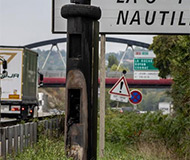
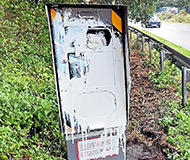
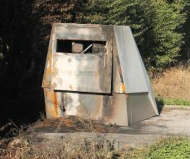
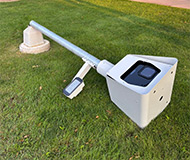
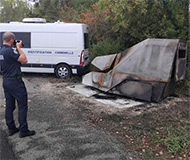
Poliscan speed cameraVigilantes burned a speed camera housing in Dorset, England last Tuesday at around 3am. A gasoline-filled tire was used to set the camera housing near the Bear Cross on fire, the Bournemouth Daily Echo reported. Officials claimed the camera housing was empty. Police have no idea who might be responsible. Three of the five new column-mounted speed camera locations in Boeblingen, Germany were attacked last week. According to Stuttgarter Zeitung, only two of the city's camera locations contain the expensive photographic and laser equipment at any given time. Vigilantes smashed or removed the columns, but did not hit the sensitive electronics, according to police. Camera locations on Maurener Way, Sindelfinger Street and Tubingen Street were hit. The municipality pays about 75,000 Euros (US $100,000) to install each of the column-mounted speed camera devices. Vigilantes in Osnabruck were able to destroy an older style of traffic camera last week. The device located on the B51 at Ostercappeln was first smashed with a hammer on January 23 at around 11pm and a 48-year-old man was taken into custody as a suspect. Last Monday, however, someone finished the job by setting the automated ticketing machine on fire, Osnabrucker Zeitung reported. The camera has been attacked a number of times since it was installed. In May 2006, the device was ripped out of the ground with a chain. In July 2006 and June 2009 it was smashed with a hammer.


website features

This is a journal covering motoring issues from around the world from a political perspective.


search tips | about us | site map

Subscribe
Receive free email or RSS news updates. RSS Feed

Key Documents
Documents, studies and memos about camera enforcement.

Archives
View previous news items.

Feedback
Contact the editors.

View Main Topics:


Popular Stories

-Missouri Cop Harassment Video

-Photo Enforcement Bans

-Most Popular Stories

Popular Studies

-Red Light Camera Study Roundup

-2007 Virginia DOT: Cameras Increase Injury Accidents

-2005 Washington Post: Accidents Doubled with Cameras

-2004 North Carolina: Red Light Camera Study (Burkey-Obeng)

-Majority Leader Armey Red Light Camera Report

-Longer Yellows Reduce Crashes (TX Transportation Institute)

-HOV/Carpool Lanes Cause Accidents


Did you know?

Since 1999, Washington, D.C. cameras have issued 4,019,023 tickets worth $305 million (as of 8/31/09).
---
Previous PageNext Page

theNewspaper.com: A Journal of the Politics of Driving
Archives | Contact | Site Map | Search | Documents | Privacy Policy